

Geopolitical Storm Sweeps Global Markets: Oil Surges, Bitcoin Plunges, U.S. Stocks Volatile
Introduction
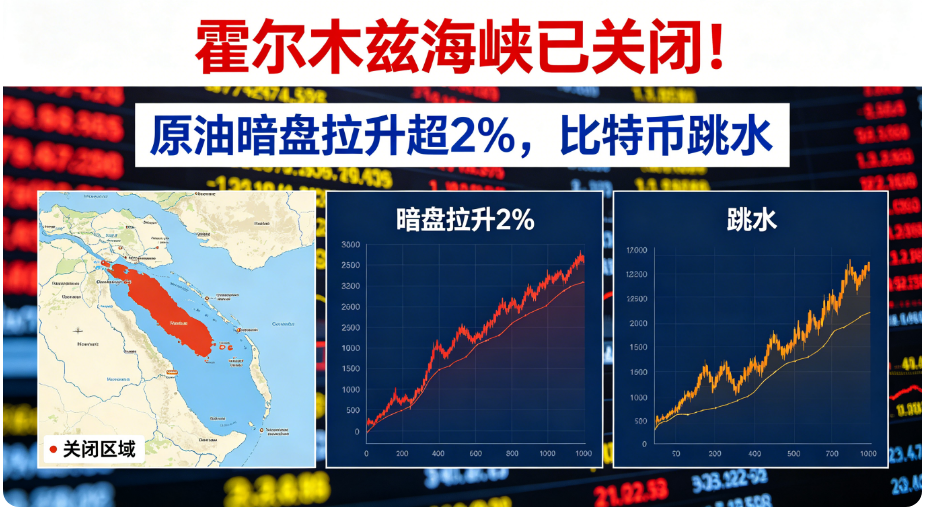
On June 22, 2025, shocking news quickly spread through financial markets: the Strait of Hormuz was closed due to escalating regional conflict. The disruption of this most critical oil shipping route immediately sent crude oil prices surging over 2%, while risk assets like Bitcoin experienced panic selling, and all three major U.S. stock indices came under pressure. Geopolitical risk once again became the dominant force in markets, with investor safe-haven sentiment rapidly heating up. This article will deeply analyze the impact of this event on crude oil, cryptocurrency, and U.S. stock markets, and explore potential subsequent trends.
Geopolitical Impact: Strategic Importance of the Strait of Hormuz
The Strait of Hormuz connects the Persian Gulf and the Arabian Sea, with about 20% of global oil passing through this waterway. Any blockade or military threat to this strait would directly disrupt the global oil supply chain. The trigger for this closure was a sudden armed conflict in the Middle East. Although parties have not yet made official statements, the market reacted quickly and violently. Looking back at history, a similar attack in 2019 caused a short-term surge in oil prices, which later subsided after the release of U.S. strategic reserves. However, current global oil inventories are relatively low, and OPEC+'s capacity to increase production is limited, making the impact of this event potentially more prolonged.
Oil Market: Supply Disruption Expectations Drive Price Jump
After the news, Brent crude futures jumped from $78.3 per barrel to $80.2, a gain of 2.4%; WTI crude broke above the $75 level. Analysts point out that the risk premium for Middle East supply disruption has quickly been reflected in prices. If the strait remains closed for more than a week, oil prices could further rise to over $85 per barrel. Meanwhile, the U.S. Department of Energy said it is assessing the possibility of tapping the Strategic Petroleum Reserve, but it cannot fully fill the supply gap in the short term. Energy stocks became one of the few gaining sectors in the U.S. stock market that day, with giants like Exxon Mobil and Chevron rising over 3%.
Notably, the oil surge was not an isolated event. Natural gas prices also rose, as geopolitical uncertainty pushed up expectations for overall energy costs. This is undoubtedly bad news for the global economy, which is in a sticky inflation period. The market began re-evaluating the Fed's future room for rate cuts, as higher energy prices may slow the pace of inflation decline.
Bitcoin Plunges: Safe-Haven Status Tested Again
While traditional safe-haven assets like gold rose slightly, Bitcoin experienced panic selling. Its price fell from $68,500 to $63,200 in a few hours, a drop of nearly 8%, the largest single-day decline in two months. This trend reflects extreme risk aversion in the current market: when faced with unpredictable geopolitical events, investors prefer to hold cash or gold rather than bear the high volatility of cryptocurrencies.
Bitcoin's narrative as 'digital gold' is again challenged. Its high correlation with risk assets was fully exposed in this event; when the fear index spikes, Bitcoin is often seen as a less liquid asset and sold off first. Additionally, open interest in Bitcoin futures on global exchanges decreased significantly, indicating forced liquidation of leveraged longs. However, from a long-term perspective, geopolitical turmoil may also strengthen some investors' belief in decentralized assets, but in the short term, the market is clearly in risk-off mode.
U.S. Stocks Under Pressure: Volatility Surges and Sector Divergence
All three major U.S. indices fell that day: the S&P 500 dropped 1.8%, the Nasdaq plunged 2.5%, and the Dow fell 1.2%. The VIX volatility index broke above 28 at one point, a new high for the year. Tech stocks were the biggest drag, with Apple and Microsoft both falling over 3%, as investors worried that rising energy costs would compress corporate profit margins. At the same time, oil-sensitive sectors like airlines and shipping also performed weakly.
In contrast, the energy sector stood out, with oil service companies Halliburton and Baker Hughes rising over 5%. Defensive sectors like utilities and healthcare also saw capital inflows. This sector rotation shows that the market is repricing risk, shifting from growth to value. More notably, the yield curve showed slight steepening, with the 10-year Treasury yield falling to 4.2%, as safe-haven capital flooded into bonds.
Historical Comparison and Future Outlook
Looking at similar past events, during the 1990 Gulf War, oil prices briefly doubled but stabilized after the Fed's emergency rate cut; after the 2019 attack on Saudi Aramco, oil prices surged 15% in a single day but fell back within a week. The key variables in this event are: the duration of the strait closure, the degree of diplomatic intervention by major countries, and OPEC+'s willingness to increase production. If the crisis eases within days, markets may see a strong rebound; if it drags on, the global economy could face a 1970s-style supply shock.
For U.S. stocks, the short-term focus should be on the following: first, whether the Fed sends dovish signals to stabilize markets; second, corporate strategies to cope with rising costs during earnings season; third, whether capital continues to flow from risk assets to safe-haven assets. The Bitcoin market may undergo a deleveraging process until the safe-haven narrative of blockchain technology regains recognition.
Conclusion
The closure of the Strait of Hormuz is like a stone thrown into a calm lake, rippling across global financial markets. Oil surging, Bitcoin plunging, and U.S. stocks volatile together outline the market's high sensitivity to geopolitical risk. Investors must recognize that in an era of increasing supply chain vulnerability, such events will no longer be black swans but gray rhinos. The core question going forward is: do central banks and governments have enough tools to mitigate the impact, and can markets find a new equilibrium amid volatility? Regardless, until the situation becomes clear, caution and diversification will be the only defense.