

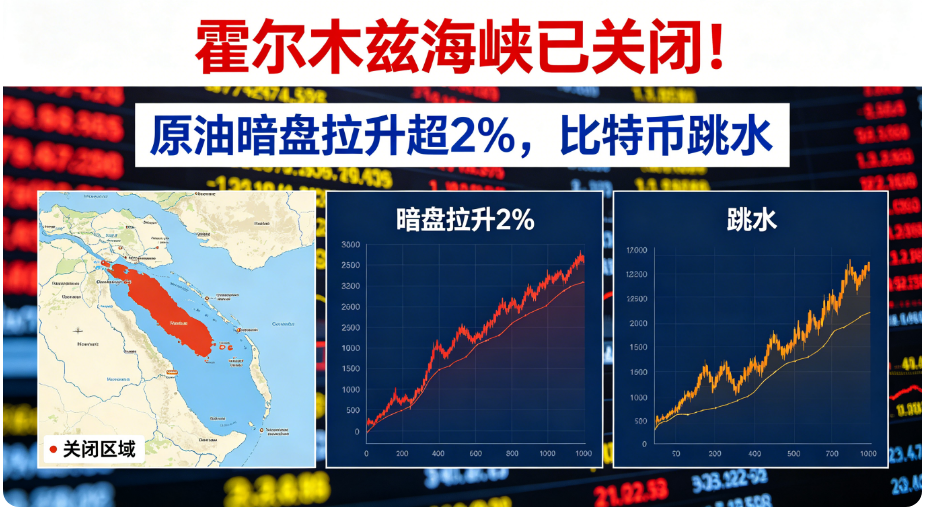
Strait of Hormuz Suddenly Closed! Oil Surges 2%, Bitcoin Plunges, 67,000 Liquidated – Middle East Powder Keg Explodes?
Hello everyone, I'm your finance and international relations observer. Today's topic is no ordinary news, but a bombshell that can instantly change the face of global financial markets – Iran officially announces blockade of the Strait of Hormuz! That's right, the strategic waterway through which one-third of the world's oil passes. As the news broke, crude oil prices surged, while Bitcoin plunged, causing over 67,000 people to be liquidated. What's the logic behind this? Why did Iran choose this moment to act? Let's analyze.
1. Accident or Inevitable? Why Did Iran Suddenly Block the Strait?
First, the conclusion: This is absolutely not a whim, but a "precise counterattack" after being pushed to the limit.
On June 20 local time, Iran's Armed Forces Khatam al-Anbiya Central Headquarters issued a statement with a very strong tone. They listed two main reasons: First, the United States blatantly violated the "first clause of the memorandum of understanding aimed at ending the war"; second, Israel continues to violate the ceasefire agreement, not only bombing heavily in southern Lebanon causing massive civilian casualties and hundreds of thousands displaced, but also still not having withdrawn its troops from southern Lebanon.
You might think these two reasons don't seem directly related to the Strait of Hormuz? That's right. Iran used a classic diversionary tactic – instead of confronting the US or Israel directly, they cut off their energy lifeline. The Strait of Hormuz, located between the Gulf of Oman and the Persian Gulf, sees about 17 million barrels of oil shipped through it every day. Once closed, the global energy supply chain would immediately break.
More importantly, the statement also said: "This is only the first step in response to the enemy's breach. If aggression continues, further measures will be taken." In other words: Don't think I'm joking; I have even harsher moves.
2. Oil Surge 2% Only an Appetizer?
After the news, the international crude oil market immediately exploded. As of Beijing time 21:23, dark crude surged over 2%. You might think 2% is not much? Don't forget, this is just the reaction within minutes, and while the news hasn't been fully confirmed and the market is still digesting. If the blockade persists, oil prices could double or more.
Let's look at historical data: During the COVID-19 pandemic in 2020, crude oil futures briefly turned negative due to demand collapse. After the Russia-Ukraine war broke out in 2022, Brent crude hit $139. Now if the Strait of Hormuz is truly closed, the daily loss of oil supply would be more than twice Russia's output. Oil prices breaking $200? Hard to imagine, but not a fantasy.
Even scarier is that this surge might not be limited to crude oil. Natural gas, shipping, commodities, even food prices could be dragged up. Because once the Middle East situation gets out of control, shipping insurance rates across the entire Persian Gulf will skyrocket, ships will have to detour around the Cape of Good Hope, transit times increase, freight costs surge, and all of it passes on to consumers.
3. Bitcoin Plunges: The Logic Behind 67,000 Liquidations
While oil prices soared, the crypto world was in agony. Bitcoin, which had risen over 2%, suddenly plunged sharply, gains shrinking to 0.9% and even turning negative. Across the global cryptocurrency market, over 67,000 people were liquidated, with severe losses.
Why did this happen? There are two logic lines:
First, the "double-edged sword" of risk aversion. Generally, geopolitical turmoil pushes some capital into safe-haven assets like gold and Bitcoin. But this time is different. An event like closing the Strait of Hormuz could trigger a massive economic recession – energy cost surges lead to runaway inflation, central banks forced to hike interest rates sharply, liquidity instantly dries up. In such an environment, high-leverage cryptocurrencies are often the first to be sold off. Investors prefer "cash is king," holding dollars or US Treasuries rather than taking risks.
Second, liquidity stampede. Within a short period, oil prices surged, large amounts of capital flowed out of other assets into crude oil-related derivatives. Bitcoin, being a highly liquid asset, was hit hardest. Combined with long-short liquidations in the futures market, short-term leveraged positions were wiped out. 67,000 people sounds like a lot, but it's a very small fraction of global crypto users. Nevertheless, it reflects extreme market fragility.
4. Middle East Situation: Next Step for the "Powder Keg"?
Back to the Middle East itself. Iran's move this time was clearly calculated. The timing is very sensitive: The international community is increasingly fatigued with the Gaza war, the US is busy with domestic elections, and internal strife in Israel is intensifying. Iran wants to pressure all parties, force the US to fulfill its promises, and compel Israel to abide by the ceasefire agreement.
But the risk is also here – closing the Strait of Hormuz is tantamount to declaring war on the world. The US Navy's Fifth Fleet is stationed in Bahrain, ready to provide armed escort at any moment. How long can Iran's blockade last? If the US military forcibly opens the waterway, will Iran use anti-ship missiles? Once a skirmish occurs, a sixth Middle East war might no longer be just a plot in novels.
Also, Gulf countries like Saudi Arabia and the UAE, though long at odds with Iran, cannot afford to see the Strait of Hormuz closed – because their oil also goes through it. This may force GCC states to join the US in economic or military countermeasures against Iran.
5. A Tip for Investors
Faced with this "epic" sudden event, what should ordinary investors do? My advice: Stay calm, don't follow the crowd.
First, the surge in oil prices is likely just short-term emotional venting. Unless the Strait of Hormuz is actually blockaded for a long time, once the situation eases, oil prices will quickly fall back. Chasing highs to go long? Be careful not to become the bag holder.
Second, Bitcoin and other crypto assets may continue to fluctuate in the short term. If you hold spot, no need to panic; if you are a futures trader, suggest immediately reducing leverage or simply closing positions to hedge. After all, in the face of a black swan of this magnitude, staying alive is the most important.
Finally, watch the subsequent developments. Iran has said "this is only the first step." So what might the second step be? Expanding the blockade? Attacking Israel? Or entering diplomatic negotiations with the US? Each path will lead to completely different market outcomes.
Summary in one sentence: Closing the Strait of Hormuz is not a minor Middle East skirmish, but a nuclear weapon-level event that can cut the global economic artery. Oil rises, crypto falls, risk aversion rises – these are just the beginning. In the next 24 hours, we may see even more astonishing market volatility. Investors, fasten your seatbelts.
Keywords: Strait of Hormuz, crude oil surge, Bitcoin plunge, liquidation, Middle East situation, Iran, Israel, US breach, safe-haven assets