

From 620 to 670: Barclays' Upgrade Code for European Stocks
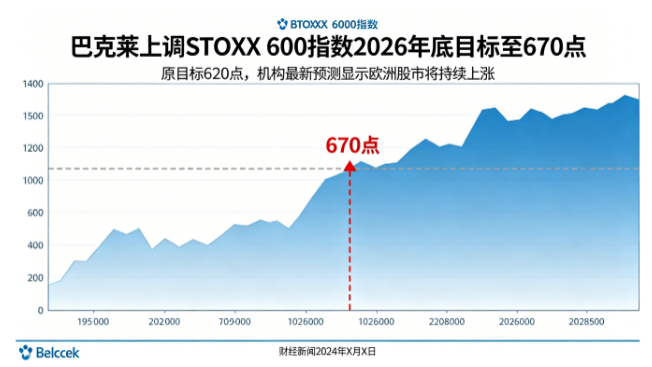
A recent financial news item caught many eyes: Barclays suddenly raised its end-2026 target for the STOXX 600 index from 620 to 670 points. This is no minor adjustment but a solid 50-point hike, a nearly 8% increase. Honestly, in today's uncertain market environment, such a bullish move is like seeing someone humming while holding an umbrella on a rainy day—it makes you take a second look.
Barclays' Big Move: More Than Just Numbers
Let's put this number in proper context. The STOXX 600 is a barometer of European equities, covering 600 companies from 17 European countries—from French luxury giant LVMH to German industrial powerhouse Siemens and Dutch semiconductor equipment maker ASML. Almost every major European company you can think of is included. When an international investment bank like Barclays targets this index and decides to significantly raise its price target, there must be solid reasoning behind it.
You might wonder: why end-2026? This is not a random choice. Barclays' analyst team has clearly done thorough homework. They believe that by end-2026, the European economy will have undergone a full recovery cycle, corporate earnings will improve markedly, and these expectations are not yet fully reflected in current stock prices. In other words, they think European stocks are currently undervalued.
This view contrasts sharply with the pessimistic "European economic stagnation" sentiment prevailing in the market. Over the past two years, the ongoing Russia-Ukraine war, energy price volatility, spillover effects from China's economic slowdown, and the ECB's continued monetary tightening have made European equities a ship navigating stormy seas. But Barclays' move suggests they see sunshine after the storm.
A Turning Point for Market Confidence?
If you look closely at recent European stock market performance, you'll see some interesting signs. Since the second half of 2023, European equities have stabilized, with volatility notably declining. This isn't because risks have disappeared, but because investors are gradually learning to find opportunities in this uncertain environment.
More notably, capital flows are shifting. According to some market data, starting from Q4 2023, more international funds have begun flowing back into European stocks. These funds come mainly from U.S. and Asian institutional investors who previously stayed on the sidelines but are now placing bets. Barclays' upgrade, to some extent, endorses this trend.
So what does Barclays see? I believe there are three main factors: first, the profitability of European companies, especially leading firms that can pass cost pressures to consumers, such as food, luxury, and healthcare companies; second, the improvement in European bank profits—rising interest rates have actually widened net interest margins, creating unexpected profit growth; and third, long-term opportunities from the energy transition, as Europe accelerates investment in green energy, providing growth momentum for companies in related supply chains.
Beyond Talk: How to Make Money?
Faced with Barclays' "bold prediction," you might wonder: how should I trade? Here are a few directions worth considering.
First, if you are a long-term investor, focus on large European companies with pricing power and competitive advantages. These firms typically have stable cash flows, strong brand moats, and robust balance sheets. In an economic recovery, they are often the first to benefit. In particular, German industrial stocks and French luxury stocks have global operations and are relatively less affected by single-region economic fluctuations.
Second, bank stocks deserve attention. European bank stocks have underperformed over the past decade, but the situation is changing. Rising interest rates are significantly improving bank profitability, and with the ECB continuing balance sheet adjustments, the valuation repair potential for bank stocks is substantial. Barclays itself is a bank, so it likely has more authority on financial stock trends than the average investor.
Third, energy transition-related stocks are another highlight. Europe has invested heavily in renewable energy, electric vehicles, hydrogen, etc., and set clear decarbonization targets. Related infrastructure, technology equipment, and service providers are expected to see growth in the coming years. German wind power equipment makers, French nuclear energy companies, and Dutch hydrogen technology firms are all worth watching.
Of course, all investments carry risks. Europe's economic recovery is not guaranteed—geopolitical risks, inflationary pressures, labor shortages, and other issues persist. Barclays' target upgrade itself is built on the assumption that "everything goes smoothly." If Europe's economy unexpectedly falters or the global macro environment deteriorates, this target may need adjustment.
Europe's "Small Blessings": Overlooked Advantages
When discussing European stocks, many people instinctively adopt a pessimistic narrative: aging economy, negative population growth, insufficient technological innovation, and so on. But these views may be oversimplified, ignoring Europe's unique strengths.
Europe's economic structure differs from that of the U.S. and China. The U.S. relies on high tech and consumption, while China centers on manufacturing and infrastructure investment. Europe's strengths lie in high-end manufacturing, fine craftsmanship, and services. These sectors may not have the explosive growth of tech stocks, but they offer strong resilience and stability. Economists often say, "Europe's economic growth rate is not high, but its quality is good." This statement holds merit.
Another often-overlooked factor is Europe's social security system and labor market structure. During economic downturns, these mechanisms act as buffers, preventing recessions from turning into systemic crises. In contrast, while the U.S. economy recovers more robustly, its social safety net is relatively weak, and economic fluctuations have a more direct impact on households and businesses. This structural difference makes European stocks more defensive when facing risks.
Furthermore, the euro's international status is an important support for European equities. Although the euro fluctuates against the dollar, it remains the world's second-largest reserve and trading currency. This means that when global markets are turbulent, funds tend to flow into dollar and euro assets, providing liquidity support for European stocks. Barclays' upgrade may also have considered this factor.
Not a Prediction, but a Strategy
Ultimately, the greater significance of Barclays' move lies in the market signal it sends: European stocks may be about to enter a new growth phase. But this is not a prediction; it is a strategic judgment. For ordinary investors, rather than obsessing over whether the target will be achieved, consider how to adjust your portfolio based on your risk tolerance and investment goals.
If you are young, you may increase your allocation to European equity funds, especially ETFs tracking the STOXX 600, which allow you to gain broad European market exposure at low cost. If you are a conservative investor, consider large, established European companies with stable dividends—their dividend yields typically range from 3% to 5%, far higher than many fixed-income products.
More importantly, don't focus solely on the index price target. The index is static; the market is dynamic. Those who truly profit in the market are often investors who understand market logic, identify individual stock opportunities, and have the patience to wait for the market to validate their judgments. Barclays' report can give you direction, but it should not replace your own research.
Conclusion: Cautious Optimism
Returning to the opening question: why did Barclays suddenly raise its target? The answer may be simple—they see opportunities others haven't yet spotted. When the market is generally pessimistic, contrarian thinking often yields excess returns. This is a basic law of investing and the survival code of Wall Street.
But we must also remember that all predictions are conditional. The path to 2026 is long, and anything can happen along the way. Europe's economic recovery, corporate earnings improvement, and geopolitical developments can all affect the final outcome. Barclays' analysts know this too—they are simply making the most reasonable judgment based on current information.
Finally, if you ask me whether you should believe this prediction, my answer is: believe, but don't blindly trust. Treat this target as a reference framework, not a guide to action. On the journey of investing, what we need is not a precise price target but a clear strategic framework and firm execution. Like those who profit long-term in the market, they never rely on predictions; they rely on systems.
The story of European stocks continues to be written, and Barclays' latest move is just one chapter. For investors, the best approach is to keep reading, keep thinking, and make your own judgments at the right time. After all, your investment success is ultimately determined by your own decisions, not someone else's predictions.