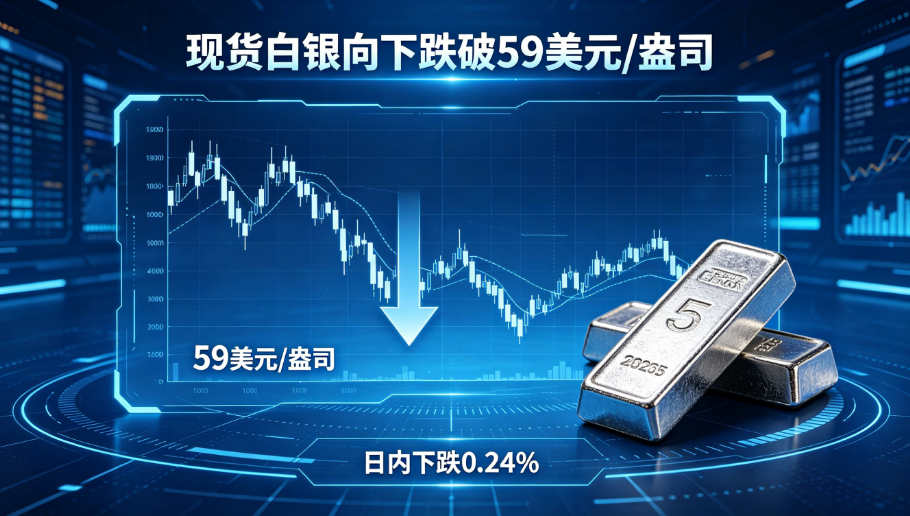


On July 30, 2026, the U.S. Department of Commerce released the preliminary Q2 Gross Domestic Product (GDP) data, which grew at an annualized rate of only 1.8%, below the market consensus of 2.0% and significantly slower than the 2.3% in Q1. Meanwhile, initial jobless claims rose to 245,000 last week, higher than the expected 238,000, indicating marginal softening in the labor market. After the data release, the U.S. Dollar Index briefly dropped to around 104.2, spot gold quickly surged to $2,955/oz, up 0.8%; spot silver also rose, breaking through the $34 mark to $34.12/oz, with a daily gain of 1.2%.
Economic Slowdown Signals Strengthen, Market Bets on Fed Pausing Rate Hikes
The lower-than-expected GDP data was primarily dragged by slowing consumer spending growth and reduced business inventory investment. Personal Consumption Expenditures (PCE) grew at a quarterly rate of 2.1%, below the previous 2.6%, indicating that high interest rates are suppressing consumer purchasing power. In addition, residential investment declined for the seventh consecutive quarter, reflecting continued weakness in the real estate market. Market analysts pointed out that this series of data further confirms that the U.S. economy is cooling in an orderly manner. Although the 'soft landing' outlook has not been completely ruled out, risks are increasing.
Fed funds futures show that the probability of the Fed keeping rates unchanged in September has risen from 78% before the data release to 85%, and expectations for a rate cut within the year have also slightly increased. Risk aversion thus rose, with funds flowing from the stock market to safe-haven assets such as precious metals. The U.S. Dollar Index fell below the key support level of 104.5, providing additional support for gold and silver prices.
Gold Breaks Above $2,950, Bullish Technical Signals Clear
From a technical perspective, spot gold formed a valid breakout near $2,950, which was previously a key resistance level contested by bulls and bears. On the daily chart, the gold price stands firmly above the 20-day moving average ($2,920) and the 50-day moving average ($2,900). The MACD indicator has formed a golden cross above the zero line, with the momentum bar turning positive; the RSI indicator has risen to 62, not yet in overbought territory, indicating room for further upside. Short-term support levels to watch are $2,940 and $2,920; if it breaks further above $2,980, it may challenge the $3,000 psychological level.
A Goldman Sachs precious metals analyst said: 'The slowdown in U.S. GDP data has strengthened gold's appeal as a safe-haven asset, while a weak dollar provides additional support. We maintain our year-end gold price target of $3,000, but if economic data continues to deteriorate, it may be reached earlier.'
Silver Follows Rise, Industrial Demand and Safe-Haven Resonance
As for silver, driven by risk aversion, spot silver broke through the $34 resistance level, reaching a high of $34.25. In addition to its safe-haven properties, industrial demand also provides underlying support. Recently, demand for silver from the solar energy industry has been rising, global green energy transition accelerates, and silver inventories have fallen from highs. Data from the Silver Institute shows that in the first half of 2026, silver industrial demand grew 6% year-on-year, with demand from the photovoltaic sector growing 12%.
On the technical front, silver holds above $33.5, with MACD and RSI both in bullish alignment. $33.8 is a short-term support; if a pullback does not break this level, the outlook may challenge $34.5. However, note that silver is usually more volatile than gold, and investors should strictly control position sizes.
Focus on Fed Meeting and Nonfarm Payrolls Data
Looking ahead, market focus will shift to the Fed's July rate decision next week (although this data was released at the end of July, the Fed's July meeting had already concluded on July 29, with rates unchanged). However, this GDP data will provide important reference for the September meeting. In addition, the July nonfarm payrolls data due on Friday is also critical; if nonfarm payroll additions fall short of expectations, it could further strengthen expectations for a pause or even a rate cut, providing sustained positive momentum for gold and silver.
In terms of safe-haven asset allocation, it is recommended that investors maintain a gold allocation of 5%-10% of the portfolio, and silver can be appropriately allocated at 2%-5%. Short-term traders can watch the key levels of $2,950 (gold) and $34 (silver); medium- to long-term long positions can be held.
Risk Warnings
- Economic data may be revised at any time, affecting market expectations.
- If Fed officials turn hawkish, it could weigh on gold prices.
- Geopolitical changes may also trigger fluctuations in risk sentiment.
Overall, the slowing U.S. economic growth combined with a softening labor market provides a favorable fundamental environment for gold and silver. Against the backdrop of ongoing global uncertainty, the safe-haven and value-preserving functions of precious metals will continue to attract capital.