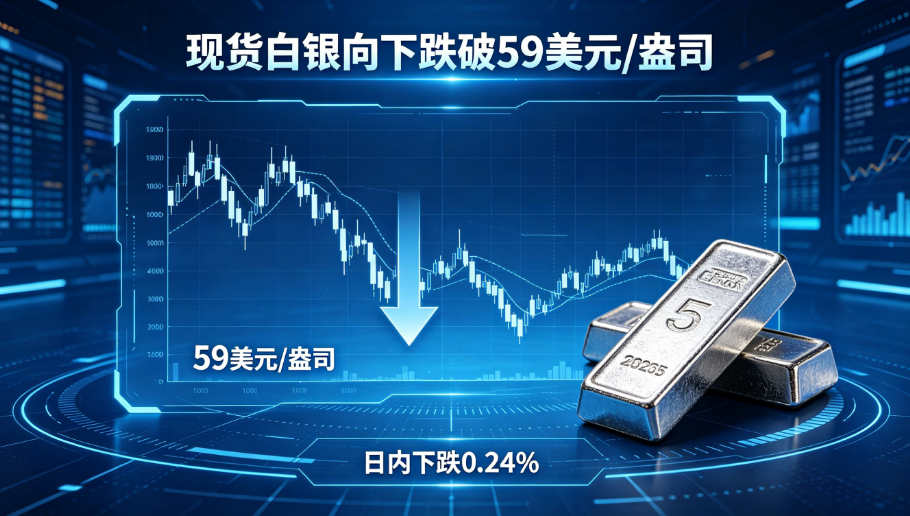


The Federal Reserve announced its interest rate decision on July 28 at 2:00 AM Taipei time, keeping the federal funds rate target range unchanged at 4.25% to 4.50%, as widely expected, and reiterated it would continue assessing inflation and employment data. After the decision, the US Dollar Index jumped 0.3% to above 104.50, and the 10-year Treasury yield also rose, weighing on precious metals. Spot gold fell from an intraday high of $3,092 to close near $3,085, down about 0.5%; spot silver broke below the $59 level, hitting a low of $58.70 and closing at $58.85, down 0.7%.
Market Review: Rate Decision in Line with Expectations; Gold and Silver Under Short-Term Pressure
This Fed meeting decision was no surprise, but the post-meeting statement was slightly hawkish, emphasizing that "inflation remains elevated" and "the labor market is still tight," interpreted by the market as limited room for rate cuts this year. Traders now see about a 45% chance of a rate cut in September, down from 55% a week ago. Interest rate futures indicate only one 25-basis-point cut this year, less than previously expected. This shift in expectations pushed the dollar and Treasury yields higher, directly pressuring dollar-denominated gold.
Over the past week, spot gold mainly fluctuated in the $3,070-$3,120 range, supported by geopolitical tensions and central bank gold purchases. But as the Fed meeting approached, profit-taking sell pressure emerged, driving gold down about $35 from the $3,120 high. For silver, industrial demand prospects remain a key variable; global manufacturing PMI data continues in expansion territory, but the recent weakness in copper prices has dragged on silver's industrial properties. At the same time, silver ETF holdings declined for three consecutive days, indicating some safe-haven capital outflow.
Factor Analysis: USD Strength is Main Source of Pressure
Fed Stance Impacts Rate Cut Expectations
Fed Chair Powell stated in the post-meeting press conference that the committee has not made any commitment to rate cuts at any specific time and that everything depends on the data. He particularly noted that core PCE annual growth is still above the 2% target and more evidence of sustained disinflation is needed. These remarks were interpreted as a correction of overly optimistic rate cut expectations, leading to a repricing of interest rate futures. For gold, a high-rate environment means higher opportunity cost of holding a non-yielding asset, resulting in clear near-term pressure.
Safe-Haven Demand and Inflation Concerns Provide Floor Support
Despite dollar strength weighing on gold prices, risk aversion remains strong. The Russia-Ukraine conflict shows no sign of easing, the Middle East situation remains tense, and global trade frictions are rising, prompting some funds to flow into gold as a safe haven. Additionally, the US fiscal deficit issue and the debt ceiling debate have resurfaced, and concerns about long-term inflation have not dissipated. This provides strong buying support for gold around $3,070. Analysts point out that as long as geopolitical risks persist, the downside for gold will be limited.
Technical Analysis: Gold Tests Uptrend Line; Silver Faces Key Support
Gold: $3,070 is the Bull-Bear Divide
On the technical chart, the uptrend line from the June low is currently near $3,070, which also coincides with the 100-day moving average. Today, gold briefly dipped below $3,080 but quickly rebounded, showing active buying in the $3,070-$3,080 zone. If gold can hold above $3,070 this week, the rebound target could be $3,120 (previous high) and $3,150 (all-time high). Conversely, if it breaks below $3,070, it could further test $3,050 (200-day moving average) or even the $3,000 round number.
- Support: $3,070, $3,050, $3,000
- Resistance: $3,100, $3,120, $3,150
- Short-term oscillators: RSI has fallen to near 50, MACD histogram is converging, suggesting balanced bullish and bearish forces.
Silver: $58.50 is the Last Defense for Bulls
Silver has underperformed gold recently, with the gold/silver ratio rising back to near 82. Silver prices have closed below $59 for two consecutive days, testing the uptrend line from June at $58.50. If that level is lost, the next support is $58.00 (previous low) and $57.00 (50-day moving average). Upside resistance is at $59.50 and the $60 round number. On the industrial demand side, Shanghai Futures Exchange silver inventories increased 2% this week, physical buying remains weak, and speculative long positions have also cooled.
Outlook: Focus on PCE and Nonfarm Payrolls
For the remaining trading days of the week, the market will focus on Friday's US June core PCE price index (estimated at 2.5% year-on-year) and July nonfarm payrolls report (estimated at 180,000 new jobs). If PCE data comes in below expectations, it could reignite rate cut expectations, benefiting gold and silver. Conversely, if it exceeds expectations, the dollar will strengthen further, and gold and silver may face downside pressure. Strong nonfarm payrolls would also reinforce the Fed's hawkish stance. Overall, gold and silver prices are likely to maintain a range-bound pattern in the short term. Investors should closely monitor the volatility around the data releases. Long-term view unchanged: geopolitical risks combined with global central bank gold buying trends support gold as a safe haven. Silver, however, needs an industrial demand catalyst and may continue to follow gold in the short term with limited upside.
In terms of trading strategy, investors are advised to mainly trade within the range: gold between $3,070 and $3,120, and silver between $58.50 and $60. Set stop-losses about $5 outside support or resistance to control risk. Once key data is released and the trend becomes clear, add positions accordingly.